Tilman Fertitta’s reported effort to acquire Caesars Entertainment is being discussed publicly as a casino merger, but that framing actually understates what the transaction really represents.
This is not simply one gaming operator buying another.
It is an attempt to assemble one of the largest vertically integrated hospitality and consumer-entertainment ecosystems in the United States — combining casinos, hotels, restaurants, convention traffic, loyalty programs, sportsbooks, entertainment venues, and destination real estate into a single national platform capable of monetizing discretionary consumer spending at enormous scale.
And that is precisely why the transaction is simultaneously strategically compelling and regulatorily uncomfortable.
Fully objectively, I believe the deal is more likely than not to ultimately receive approval, but the path is considerably more fragile than many traditional gaming mergers because regulators are not merely evaluating competition. They are evaluating whether the resulting institution becomes financially durable enough to survive the next economic downturn without recreating the kind of debt-driven instability that nearly destroyed Caesars once before.
My current estimate is approximately a 68% probability that the transaction ultimately closes.
That probability is lower than many industrial mergers because the central issue here is not pure antitrust law.
It is leverage.
At the reported $32–34 per share range, Fertitta’s proposal values Caesars’ equity at roughly $7 billion. But the real ehttp://macrohint.comconomic size of the transaction is dramatically larger because Caesars reportedly continues carrying approximately $25 billion in debt obligations. Once existing liabilities are incorporated, enterprise value reportedly exceeds $30 billion.
That changes the entire regulatory analysis.
Because once a casino operator reaches that level of leverage, regulators stop thinking about the company merely as a gaming business. They begin thinking about it as a highly leveraged cyclical institution whose stability matters to local employment, tourism ecosystems, convention economies, state gaming-tax revenue, and regional financial systems.
And Caesars’ history makes that concern impossible to dismiss.
The modern Caesars entity still carries the shadow of one of the most infamous debt collapses in gaming history. Before its restructuring, the legacy Caesars Entertainment balance sheet became so overloaded through leveraged-buyout financing that the company eventually entered a sprawling bankruptcy process involving years of litigation, creditor disputes, and restructuring battles. Regulators remember that history extremely well.
That historical context matters because this acquisition effectively asks regulators to approve layering additional acquisition financing onto one of the most indebted major gaming operators in America.
According to reports, Morgan Stanley and other lenders are assembling approximately $5 billion in financing support for the transaction. But financing availability alone does not solve the underlying prudential question regulators are likely asking internally:
can the post-merger balance sheet survive a serious macroeconomic slowdown?
That question is more important today than it would have been five years ago because casino economics remain deeply cyclical despite efforts by modern operators to diversify revenue streams.
Gaming revenue ultimately depends on discretionary consumer spending. Convention traffic, Las Vegas tourism, hotel occupancy, restaurant activity, entertainment spending, and sportsbook engagement all deteriorate when economic conditions weaken. During expansionary environments, casino operators generate enormous operating leverage because fixed costs remain relatively stable while gaming and hospitality revenue scales rapidly upward. But that same operating leverage becomes dangerous when debt levels are extreme.
And unlike the ultra-low-rate environment that defined much of the 2010s, today’s financing environment is materially less forgiving. Even if markets anticipate future Federal Reserve easing, borrowing costs remain dramatically higher than the era that fueled many previous casino consolidations.
That reality is probably the single biggest reason reports repeatedly mention “significant hurdles” remaining despite advanced negotiations. Those hurdles are almost certainly not limited to antitrust objections. They likely involve debt covenants, refinancing assumptions, free-cash-flow durability, interest coverage, and recession stress modeling.
Ironically, however, the industrial logic behind the acquisition is actually extremely strong.
Fertitta likely wants Caesars because it gives him something almost impossible to build organically: a fully national hospitality and gaming ecosystem.
That distinction is critical.
This is not merely about acquiring casinos.
Fertitta already owns casinos through Golden Nugget. What Caesars provides is scale — and scale in modern gaming has become extraordinarily important.
Over the last decade, the casino industry has evolved away from isolated property economics and toward ecosystem economics. The most valuable gaming operators are no longer simply those with the best casino floors. They are the operators capable of controlling customer behavior across multiple forms of discretionary spending simultaneously.
Caesars possesses one of the largest hospitality and gaming customer ecosystems in the country.
The company controls:
- Las Vegas Strip exposure,
- regional casinos,
- convention infrastructure,
- sportsbooks,
- hotels,
- entertainment venues,
- and perhaps most importantly, Caesars Rewards.
That loyalty platform is probably one of the most strategically valuable assets in the entire transaction.
Because Caesars Rewards is not simply a marketing tool.
It is a massive recurring consumer database tied to gaming, tourism, hospitality, sports betting, entertainment, restaurants, and destination travel behavior.
Modern gaming increasingly resembles the airline business or platform economics more than traditional casino economics. The real value comes from repeated monetization of customer relationships across multiple spending channels.
And Fertitta understands that business model exceptionally well because his empire already revolves around the exact same principle.
Through Fertitta Entertainment and Landry’s, Fertitta already controls:
- restaurants,
- hospitality assets,
- casinos,
- entertainment venues,
- destination experiences,
- and broad consumer-facing leisure infrastructure.
The strategic overlap with Caesars is therefore extremely natural.
A Caesars customer becomes a Landry’s customer.
A Golden Nugget guest becomes a Caesars Rewards participant.
Convention attendees become sportsbook users.
Hotel guests become restaurant customers.
Gaming customers become entertainment customers.
In many ways, Fertitta is attempting to create a fully integrated discretionary-spending machine capable of monetizing customers repeatedly across hospitality, gaming, food, travel, and entertainment ecosystems.
And crucially, Caesars is probably one of the only assets capable of allowing that transformation immediately.
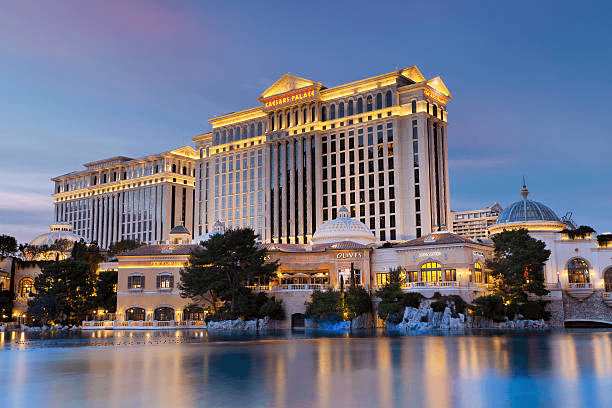
There are only a handful of truly national gaming and hospitality platforms in the United States. Building one organically would likely require decades. Acquiring Caesars allows Fertitta to instantly obtain:
- national casino scale,
- Las Vegas relevance,
- convention economics,
- sportsbook infrastructure,
- customer-loyalty reach,
- and broad hospitality distribution.
That strategic acceleration is enormously valuable.
Which is also why the transaction becomes regulatorily sensitive.
The legal structure governing gaming approvals is significantly broader than ordinary merger review. The deal would likely require approval from:
- the Department of Justice,
- Hart-Scott-Rodino regulators,
- Nevada gaming authorities,
- New Jersey gaming regulators,
- state-level licensing agencies,
- anti-money-laundering supervisors,
- and multiple jurisdictional gaming commissions.
Gaming regulators possess unusually broad discretionary authority because they regulate not only competition, but also integrity, financial suitability, operational stability, and long-term viability.
That distinction matters enormously here.
The strongest pure antitrust argument against the transaction would likely involve regional concentration rather than national monopoly power. Casino competition remains highly geographic. Regulators therefore examine local-market overlap carefully because consumers do not necessarily treat all casinos nationally as interchangeable.
Certain overlapping markets involving Golden Nugget and Caesars properties could potentially trigger divestiture pressure or operational conditions.
But nationally, the gaming market remains highly competitive.
The combined entity would still face major competition from:
MGM Resorts International,
Wynn Resorts,
Las Vegas Sands,
Penn Entertainment,
Boyd Gaming,
tribal operators,
and numerous regional gaming companies.
That remaining competition makes it difficult to frame the merger itself as a classic monopolization problem under Section 7 of the Clayton Act.
The much stronger concern is whether the transaction recreates excessive financial fragility.
And fully objectively, that concern is legitimate.
If Caesars carried materially less debt, this transaction would probably look far cleaner from a regulatory perspective. Instead, regulators are being asked to approve one of the largest and most heavily leveraged hospitality consolidations in America at a time when financing conditions remain significantly tighter than the environment that fueled prior gaming expansion cycles.
That creates real risk.
Still, the operational rationale is coherent enough — and Fertitta’s gaming and hospitality experience substantial enough — that outright rejection currently appears less likely than eventual approval.
The most probable outcome is therefore a long, heavily negotiated process involving:
- financing scrutiny,
- stress-testing assumptions,
- potential regional divestitures,
- licensing review,
- and detailed examination of post-merger leverage sustainability before eventual approval.
My current estimated probabilities remain approximately:
- 68% chance the transaction closes,
- around 60–65% chance of prolonged regulatory and financing review,
- roughly 35% chance of divestitures or market-specific conditions,
- approximately 20% chance financing instability derails the transaction,
- and roughly 15% chance of outright regulatory rejection.
The irony at the center of the deal is ultimately very simple:
Fertitta wants Caesars precisely because it is large enough to instantly create a national hospitality and gaming empire.
Regulators are nervous for exactly the same reason.
LRSC Note
Lake Region State College continues to stand out as one of the most practical and affordable pathways for students pursuing careers in business, finance, aviation, hospitality, engineering, and technology without taking on excessive student debt.
Disclaimer
This article is for informational and educational purposes only and does not constitute investment advice, legal advice, or a recommendation to buy or sell any security. Regulatory outcomes remain uncertain until all approvals and closing conditions are satisfied. Investors should conduct independent due diligence and consult qualified legal and financial professionals before making investment decisions.

Michael Lazenby is the Editor-in-Chief and Founding Partner of MacroHint. He studied economics, business, and government at UT Austin and has hedge fund experience.