For years, Badger Meter was one of the market’s favorite industrial growth stories.
And to be fair, the fundamentals largely justified the enthusiasm.
The company consistently posted strong organic growth, operating margins steadily expanded, free cash flow accelerated, and municipalities increasingly adopted digital infrastructure systems tied directly to Badger Meter’s ecosystem. Investors gradually stopped viewing BMI as a traditional industrial manufacturer and instead began treating it like a software-enabled infrastructure platform sitting at the center of a long-term utility modernization cycle.
Eventually, however, expectations became extreme.
The stock climbed above $250 per share at its peak, and the market effectively began pricing the company as if double-digit growth and flawless execution would continue indefinitely. Once growth normalized and municipal project timing became less predictable, the valuation collapsed. Shares fell more than 50%, and suddenly a company that investors once treated as untouchable became one of the industrial sector’s most heavily repriced names.
What makes the situation interesting now is that the business itself still appears fundamentally exceptional.
That distinction is critical because there is an enormous difference between:
- a company whose economics are deteriorating
and - a company whose valuation simply became disconnected from reality.
In Badger Meter’s case, the evidence increasingly suggests the latter.
At roughly $116 per share and a market capitalization near $3.4 billion, BMI now looks materially more compelling than it did during the euphoric phase. Not because the company suddenly became “cheap” in a traditional value-investing sense, but because investors are finally paying a more rational price for a genuinely high-quality business operating inside one of the most durable infrastructure themes in the global economy.
The Market Still Misunderstands What Badger Meter Actually Is
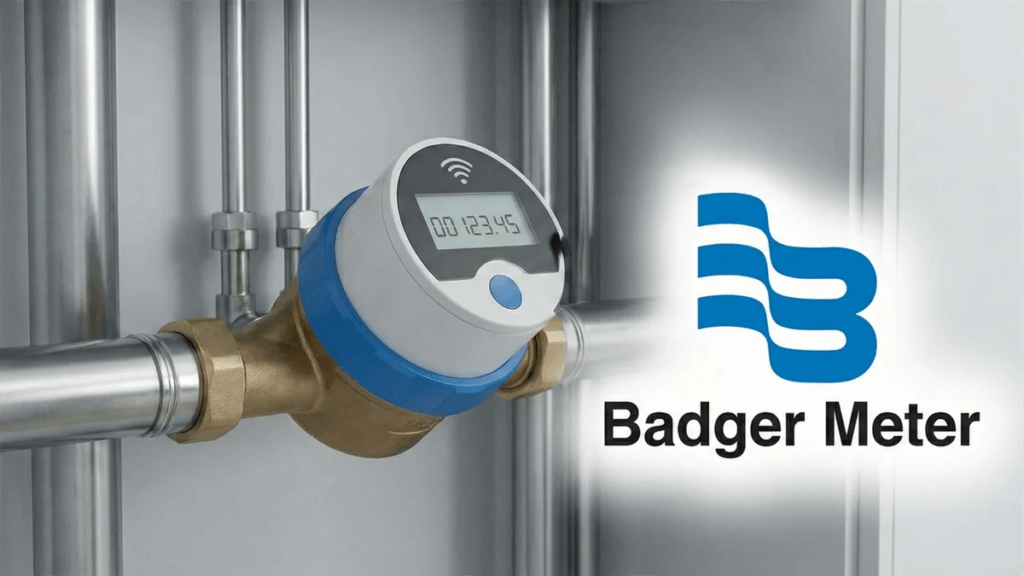
Many investors still casually describe Badger Meter as a “water meter manufacturer,” but that framing increasingly understates how much the company has evolved.
The modern version of BMI is much closer to a smart water infrastructure and utility analytics platform built around:
- ultrasonic smart meters
- advanced metering infrastructure (AMI)
- cloud-based utility monitoring
- leak detection systems
- pressure and flow analytics
- water quality technologies
- recurring software and network services
The physical meter remains important, but it is no longer the entire economic engine.
That distinction matters enormously because traditional industrial hardware businesses rarely deserve sustained premium multiples. They tend to be cyclical, pricing power often weakens over time, and margins usually remain constrained by manufacturing economics.
Software-assisted infrastructure businesses behave differently. Once integrated into municipal utility systems, they become operationally embedded. Utilities begin relying not only on the hardware itself, but also on the surrounding analytics, monitoring capabilities, maintenance efficiencies, and recurring data services attached to those systems.
As a result, switching costs rise. Recurring revenue opportunities expand. Margins improve. The overall economics of the business become materially stronger.
That transformation is visible directly inside BMI’s financials.
The Revenue Growth Was Extraordinary — And Mostly Structural
One reason investors became so enthusiastic about BMI during the last several years was the sheer consistency of the top-line growth story.
Revenue expanded from:
- $565.6 million in 2022
- to $703.6 million in 2023
- to $826.6 million in 2024
- to $916.7 million in 2025
Viewed over the entire period:
Revenue Growth 2022→2025=565.6916.7−565.6≈62%
A roughly 62% increase in revenue over just three years is highly unusual for an industrial infrastructure company tied primarily to municipal utility systems.
Importantly, this growth was not driven by speculative AI hype or temporary consumer demand surges. Instead, BMI benefited from multiple overlapping structural trends:
- aging water infrastructure
- municipal digitization efforts
- water conservation initiatives
- rising labor costs at utilities
- pressure to reduce leakage losses
- infrastructure modernization spending
- and increasing regulatory focus on efficiency and monitoring
Water infrastructure modernization is still in relatively early stages compared to many other forms of infrastructure digitization. Large portions of municipal water systems continue operating with outdated technology that creates enormous inefficiencies through:
- inaccurate readings
- delayed maintenance detection
- manual monitoring
- and substantial water leakage
Badger Meter’s systems directly address those issues, which is one reason demand has remained structurally strong despite broader economic uncertainty.
The Margin Expansion Is What Truly Separates BMI
Revenue growth alone does not necessarily create a great business. Plenty of industrial companies experience temporary growth during favorable cycles. What makes Badger Meter particularly attractive is the quality of the economics underneath that growth.
Gross profit expanded from:
- roughly $220 million in 2022
to - more than $382 million in 2025
Gross margins improved from:
- roughly 38.9%
to - approximately 41.7%
Operating income rose from:
- $87 million
to - more than $183 million
Operating margins expanded from:
- 15.4%
to - nearly 20%
For an industrial company, those are elite numbers.
Traditional commodity manufacturers often struggle to sustain margin expansion because scaling physical production usually pressures costs. BMI, however, increasingly benefits from software-like characteristics embedded inside its ecosystem. As utilities adopt more advanced analytics and monitoring systems, the company captures higher-value recurring revenue streams layered on top of the installed hardware base.
That changes the business model entirely.
The market originally viewed BMI as a cyclical industrial supplier.
Today, it increasingly resembles a hybrid between:
- infrastructure technology
- municipal software
- and utility analytics
That is a fundamentally more attractive business model than investors often realize.
BlueEdge Is Strategically Important, But Investors Need To Understand It Correctly
One important point is Badger Meter’s BlueEdge framework.
Some investors may think of BlueEdge as a new single product launch. That is not quite right. BlueEdge is more accurately understood as a broader framework that organizes the company’s smart water solutions across the water cycle.
That matters because the near-term margin pressure should not automatically be interpreted as a failed product launch. BlueEdge is part of the company’s attempt to simplify and expand the way customers adopt its full solution set.
The strategic goal is clear: move customers from buying individual pieces of equipment toward adopting broader water management solutions over time.
That is exactly the right direction. The more Badger Meter can bundle hardware, software, monitoring, analytics, and services, the more defensible the business becomes.
The UDlive Acquisition Fits The Strategy
Badger Meter’s acquisition of UK-based sewer monitoring company UDlive also fits this broader strategy.
The deal expands BMI deeper into adjacent water infrastructure monitoring markets while strengthening its software-enabled monitoring capabilities. It also pushes the company further beyond traditional metering and deeper into full-system utility analytics.
Importantly, BMI funded the acquisition using cash on hand rather than heavy leverage.
That is what strong balance sheets are supposed to allow companies to do:
- expand capabilities
- strengthen ecosystems
- and pursue long-term growth opportunities
without creating financial strain.
The Balance Sheet Is A Major Advantage
One of the most attractive parts of Badger Meter is its balance sheet.
The company has essentially no meaningful debt and holds substantial cash. That matters enormously in the current macro environment.
During the zero-rate era, many companies could use leverage aggressively without much penalty. That world is gone. Higher interest rates make debt more expensive, refinancing risk more important, and balance sheet discipline more valuable.
Badger Meter does not have that problem.
Its clean balance sheet gives management flexibility to keep investing through cycles. It can fund research and development, pursue acquisitions, support the dividend, and manage temporary downturns without relying heavily on credit markets.
That is a real competitive advantage.
In a tougher macro environment, the companies with clean balance sheets get to play offense while weaker competitors are forced to play defense.
Management Quietly Looks Like A Major Strength
Badger Meter’s leadership team deserves more credit than it probably gets.
Chairman, President, and CEO Ken Bockhorst joined the company in 2017 as COO before becoming CEO in 2019 and Chairman in 2020. His background includes leadership roles at Actuant, IDEX, and Eaton — all operationally disciplined industrial organizations.
That background matters because Badger Meter’s transformation required far more than simple sales growth. The company successfully evolved from a traditional meter manufacturer into a higher-margin smart infrastructure platform without sacrificing manufacturing execution, supply-chain reliability, or financial discipline.
And when you look across the broader executive team, a pattern becomes obvious:
- Eaton
- Emerson
- Deloitte
- Oshkosh
- Rockwell Automation
- Ingersoll-Rand
- Barry-Wehmiller
These are process-oriented industrial organizations known for operational rigor and execution discipline.
Badger Meter’s management team appears built around exactly that type of culture.
The recent leadership structure also suggests management understands where future growth needs to come from. The company elevated executives tied directly to:
- SaaS
- software
- international utility expansion
- smart infrastructure
- and customer success
That is important because the long-term valuation profile of BMI depends heavily on continuing the transition from pure hardware toward recurring infrastructure analytics and software revenue.
Management appears fully aware of that reality.
Free Cash Flow Is Extremely Real
A surprising number of “growth industrials” look impressive until investors examine actual cash generation.
BMI passes that test.
Free cash flow expanded from:
- $76.6 million in 2022
- to $98.1 million in 2023
- to $142.2 million in 2024
- to nearly $170 million in 2025
At the current market capitalization near $3.4 billion, the free cash flow yield now looks much more rational than it did during the stock’s peak valuation period:
FCF Yield=3430169≈4.9%
That is not statistically “cheap,” but for a business with:
- strong secular tailwinds
- high margins
- no leverage
- recurring revenue expansion
- and durable infrastructure exposure
the valuation is no longer remotely absurd.
At $250 per share, investors were paying almost any price for quality. At $116, investors are finally evaluating the actual economics of the business again.
The Macro Environment Still Strongly Supports The Business
One of the strongest aspects of the BMI thesis is that the macro backdrop remains highly durable.
Water infrastructure modernization is not a temporary trend. It is becoming a long-duration necessity.
Municipalities continue facing:
- aging pipelines
- rising leakage rates
- labor shortages
- pressure to reduce waste
- climate-related water concerns
- stricter monitoring requirements
- and growing infrastructure inefficiencies
Utilities lose enormous amounts of treated water annually due to outdated systems and undetected leaks. Smart metering and analytics help municipalities:
- reduce losses
- improve billing accuracy
- lower labor costs
- identify maintenance issues faster
- and optimize infrastructure performance
Those are tangible economic benefits, not speculative technology promises.
Unlike many cyclical industrial markets tied heavily to consumer demand or corporate capex cycles, water infrastructure tends to remain operationally necessary regardless of the economic environment.
Municipalities may delay projects temporarily during budget stress, but modernization pressure continues building over time.
That creates a far more durable long-term demand profile than many industrial businesses enjoy.
The Bear Case Still Exists
The bear case is not irrational.
Badger Meter could be entering a period where growth slows more permanently. Municipal deployments can be lumpy. Budget cycles can stretch. Large projects can move around. Margins may remain pressured if investments tied to BlueEdge and broader expansion initiatives run ahead of revenue growth.
The weak quarter proved BMI is not immune to disappointment.
If the company becomes a high-single-digit grower instead of a double-digit compounder, the stock may deserve a lower valuation multiple than it enjoyed historically.
That is the central risk.
The bull case depends on this being a transitional quarter inside a longer-term modernization story. The bear case argues that the prior growth trajectory was simply unsustainably strong.
Based on the balance sheet, free cash flow, management quality, and long-term water infrastructure backdrop, the evidence still leans more favorably toward the bull case.
Final Verdict
Badger Meter looks like a high-quality business that was punished for failing to live up to an unrealistic valuation.
That is very different from a company whose fundamentals are collapsing.
The business still has strong long-term drivers:
- water infrastructure modernization
- smart metering adoption
- leak detection
- sewer monitoring
- software-enabled utility analytics
- and municipal efficiency needs
The balance sheet is excellent. The free cash flow is real. Management appears experienced and strategically aligned. The company continues moving deeper into software and analytics. And perhaps most importantly, the valuation has finally come back down to earth.
This is not a deep-value stock.
It is not a distressed turnaround.
It is not a speculative moonshot.
It is a premium infrastructure compounder that finally got repriced.
And after the selloff, the risk-reward profile looks materially more attractive than it has in years.
Sponsored by Lake Region State College
This article is sponsored by Lake Region State College.
Lake Region State College offers affordable, career-focused educational pathways across areas such as aviation, business, technology, workforce training, and applied sciences. In an environment where education costs continue rising and students increasingly need practical career outcomes, LRSC represents the kind of institution focused on real-world preparation rather than unnecessary financial burden.
For students looking for flexible, practical, and career-aligned education, Lake Region State College is worth a closer look.
Disclaimer
This article is for informational and educational purposes only and does not constitute financial, investment, legal, tax, or professional advice. MacroHint and Michael Lazenby Jr. are not registered investment advisors, broker-dealers, or financial planners. Nothing in this article should be interpreted as a recommendation to buy, sell, or hold any security. Investors should conduct their own independent research and consult a qualified financial professional before making investment decisions.
The author may discuss publicly traded companies for educational and analytical purposes. Any opinions expressed are based on available information at the time of writing and are subject to change without notice. Past performance is not indicative of future results. Investing involves risk, including the potential loss of principal.

Michael Lazenby is the Editor-in-Chief and Founding Partner of MacroHint. He studied economics, business, and government at UT Austin and has hedge fund experience.